
Artigos
Housing segregation in Rio de Janeiro: a dead-end street? Analysing the impact of low-rise residential cul-de-sacs types on Rio de Janeiro’s street network through Space Syntax
AUTORIA: Valeria Ena
ANO: 2022
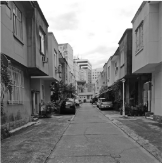
The main objective of this study is to understand the impact of low-rise residential dead-ends on the movement to and through Rio de Janeiro’s street network at local radii. More specifically, it compares vilas (a traditional terraced type along a gated alley), rowhouse cul-de-sacs, favelas’ linear dead-end clusters and comb-like gated communities, focusing on the relationship between the housing units, the internal dead-end street or alley, the main public street and the local surroundings. The intention is to understand if, and through which spatial features, different types of low-rise residential dead-ends affect the connectivity and, thus, people’s movement in the city’s public space.
The paper first reassesses the historical progression of Rio’s low-rise residential dead-ends since the backyard inline houses imported by the Portuguese into the modern row-house estates and gated communities. Then it compares the topological depth and micro-scale features of the selected types. Finally, it analyses their impact at local radii through the Space Syntax Angular Segment Analysis of Rio’s RCL map.
The results show that: 1) vila type demonstrates that it is possible to have some degree of residential segregation without compromising the public streets’ vitality and, therefore, safety; 2) favelas’ dead-end clusters on flatlands and the traditional vilas are topologically identical and have a similar impact on the surroundings; 2) gated condominiums of row and detached houses are similar to the vilas layout but their complete lack of fronts permeability and increased topologic, and metric depth have a critical impact on the movement to and through the surroundings.
COMO CITAR: ENA, V. Housing segregation in Rio de Janeiro: a dead-end street? Analysing the impact of low-rise residential cul-de-sacs types on Rio de Janeiro's street network through Space Syntax. In: INTERNATIONAL SPACE SYNTAX SYMPOSIUM, 13., 2022, Bergen. Proceedings of the 13th International Space Syntax Symposium. Bergen: Department of Civil Engineering, Western Norway University of Applied Sciences, 2022.